How We Scaled Our Long-Form Content Output from 5 to 9 Pieces a Month — Using a Claude Skill
Every content team hits the same wall. You know what you want to publish. You know the tone, the structure, the audience, the things you never say. But the moment a second person touches a draft, something goes off. The voice drifts. A banned phrase sneaks in. The CTA for an awareness post reads like a sales push. You spend more time correcting than creating. That was us. For most of 2025, Simplex Wireless was producing five long-form content pieces per month — not because we lacked topics, but because the brand knowledge required to execute them lived in one person's head and couldn't scale. Then we built a Claude skill. This is the story of how that works, what it contains, and how it got us to nine pieces a month without diluting quality.
Luca Lundgren
4/7/20265 min read
The bottleneck wasn't ideas. It was institutional knowledge locked inside one person's head.
Every content team hits the same wall. You know what you want to publish. You know the tone, the structure, the audience, the things you never say. But the moment a second person touches a draft, something goes off. The voice drifts. A banned phrase sneaks in. The CTA for an awareness post reads like a sales push. You spend more time correcting than creating.
That was us. For most of 2025, Simplex Wireless was producing five long-form content pieces per month — not because we lacked topics, but because the brand knowledge required to execute them lived in one person's head and couldn't scale. Then we built a Claude skill. This is the story of how that works, what it contains, and how it got us to nine pieces a month without diluting quality.
What a Claude Skill Actually Is
Claude, the AI built by Anthropic, supports a feature called Skills. A skill is a document — a structured SKILL.md file — that you upload to Claude's memory. It contains everything Claude needs to behave like a trained team member for a specific task: brand voice rules, content templates, vocabulary restrictions, structural guidelines, and quality checks.
The difference between prompting Claude with a paragraph of instructions and giving it a skill is the difference between briefing a new contractor before each call and hiring someone who already knows the job. The skill persists. You don't re-explain your brand every time.
For content teams, this matters enormously. Once the skill exists, anyone on the team — or Claude operating within it — can produce on-brand long-form content without the institutional knowledge bottleneck.
What We Put in the Simplex Wireless Skill
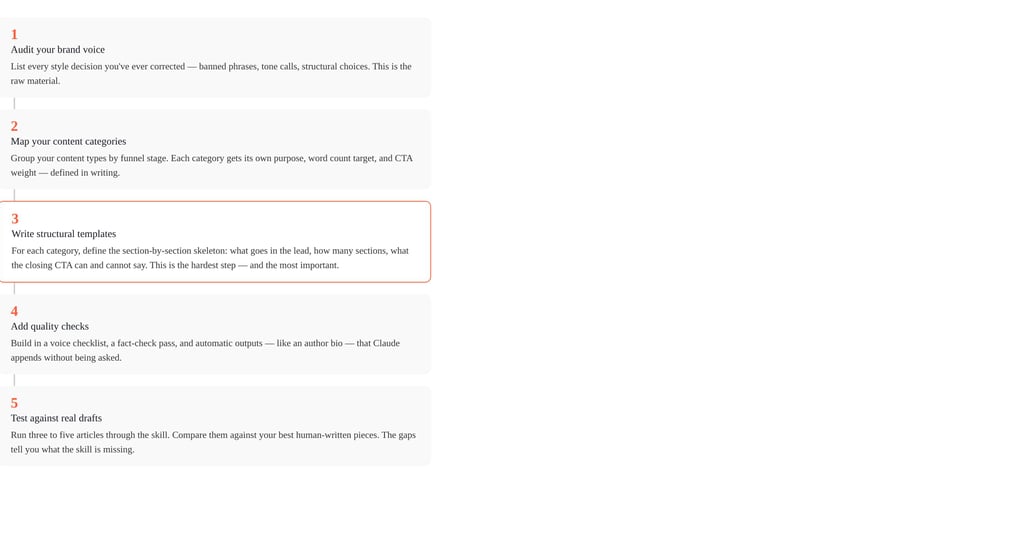
Building the skill took about two weeks of deliberate work. We didn't write it from scratch; we distilled years of brand decisions, editorial choices, and quality vetoes into a structured document. Here's what it covers.
Figure 1 — Step sequence: how to build a Claude skill
Voice profile first. The skill opens with a complete brand voice profile: five voice attributes rated on a scale, a vocabulary allowlist and blocklist, grammar rules, tone guidelines, sample phrases marked on-brand and off-brand with explanations for each. If a word like "leverage" or "utilize" appears in a draft, the skill flags it before delivery.
Seven content categories, each with its own template. This is the core of the skill. Every category has a defined purpose, word count range, CTA weight, section-by-section structure, and a voice checklist. Writing a Technology Guide requires a different structure and a different CTA than writing a Learn post — and the skill enforces that automatically.
Visual table specifications. Every article produced with the skill includes two or three inline visual tables rendered in Simplex brand colors. The skill defines eight visual formats and which combinations work for each category. No format repeats within a single article.
Internal linking rules. The skill instructs Claude to fetch the Simplex news index before every article and embed four to five internal links on relevant anchor text already in the draft. Not a separate links section — inline, the way readers actually follow them.
A mandatory fact-check pass. Before delivery, the skill runs every specific claim through a three-question check: is it verifiable, is it inferred, or is it a number that needs sourcing? Uncertain claims are removed rather than weakly qualified.
Automatic author bio. For four of the seven categories — Learn, Industries, Buying Guide, and Technology Guide — the skill appends Jan Lattunen's author bio without being asked.
The Seven Content Categories
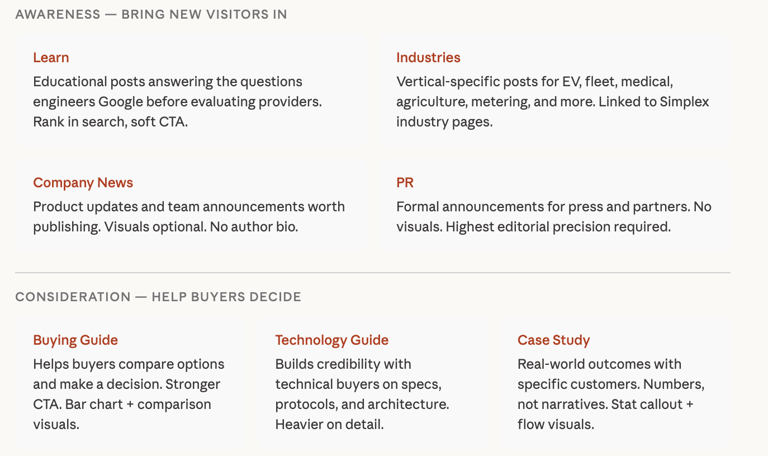
This is the architecture that made scaling possible. Rather than treating "content" as a monolith, the skill divides output into seven distinct types, each mapped to a funnel stage.
Figure 2 — The seven content categories
Awareness-stage categories are designed to bring new visitors in through search and brand exposure. Learn posts answer the technical questions engineers Google before they start evaluating providers — what an APN is, how eSIM provisioning works, what SGP.32 changes. Industries posts serve vertical-specific search intent: EV charging, fleet management, medical devices, agriculture, metering. Company News and PR handle announcements and formal press releases.
Consideration-stage categories reach buyers who are already evaluating options. Buying Guides help them compare and decide. Technology Guides build credibility with technical buyers who want to understand the spec before they trust a vendor. Case Studies prove real-world outcomes with specific customers — numbers, not narratives.
Each category has a different word count target, a different CTA approach, and a different visual strategy. An awareness post uses a soft CTA ("explore our coverage map") while a consideration post can push harder ("talk to our team"). The skill enforces this distinction every time.
From 5 to 9: What Actually Changed
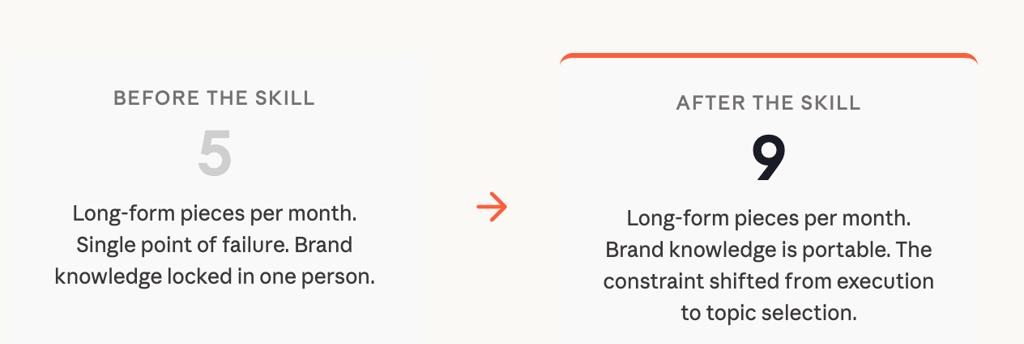
The output increase wasn't about working faster. It was about removing the single point of failure.
Figure 3 — The output jump
Before the skill, every piece had to pass through one person for brand alignment. That person was the constraint — not because they were slow, but because brand knowledge wasn't portable. The skill made it portable.
With the skill in place, a second person on the team could produce a first draft that met the same standard. Claude, operating within the skill, handles structure, voice, vocabulary, visuals, internal links, fact-check, and bio automatically. The human role shifted from execution to editorial judgment: choosing topics, reviewing drafts, adding proprietary detail Claude can't infer.
Four additional pieces per month is the direct result of that shift. And because the skill is a document — not a prompt, not a habit — it doesn't degrade. The brand knowledge doesn't leave when someone leaves.
How to Build This for Your Team
If you're running content for a technical B2B brand and hitting the same bottleneck, the process is replicable. Start by auditing what makes your best content good — not in the abstract, but in specifics: the phrases you always use, the phrases you never use, the structure that performs, the mistakes you keep correcting. Turn that into a document. Then turn the document into a Claude skill.
The skill doesn't replace editorial judgment. It protects it — so you can spend that judgment on things only humans can do.
+358 44 294 1111
© 2025. All rights reserved.
Business ID: 3131940-1
Leppäsuonkatu 9B 27/1, 00100 Helsinki